

Boarding Up London City Airport (E16) – Emergency & 24/7 Property Securing
If you need boarding up near London City Airport, you usually need it quickly: a smashed window, a forced door, or a damaged shopfront can’t be left open overnight—especially in a high-footfall, high-visibility area like E16. Boarding Up East London provides 24/7 emergency boarding up in London City Airport and across E16, helping you secure property and make the building safe until permanent repairs or glazing can be arranged.
We don’t promise unrealistic arrival times. Traffic conditions around the airport, the A-roads, and river crossings can change quickly—especially during peak travel hours or late-night closures. When you call, we’ll take a few key details and give you a realistic ETA on the phone, then prioritise genuinely urgent “make safe” jobs.
You’ll be dealing with a team that’s been trading for 10+ years, is fully insured, and uses DBS-checked technicians—important when the property is occupied, a business is still trading, or access is being managed by facilities/security.
Need help now? Call 020 4634 6384 (24/7) or email [email protected].
Why boarding up matters around London City Airport (E16)
E16 is a mix of airport-adjacent commercial units, modern flats, older industrial buildings, and busy travel routes. That blend creates a few common risk patterns we see time and again in the area:
1) High footfall + visibility = faster opportunistic damage
Around transport hubs like London City Airport and the wider Royal Docks area, buildings often sit in plain sight of passing traffic and pedestrians. A single broken pane can attract attention—especially if the property looks empty or the damage suggests a recent incident.
If you’re dealing with a smashed window, boarding up isn’t just about keeping the rain out. It’s about preventing:
- further entry attempts and theft
- injury risks from loose glass (particularly at street level)
- escalating damage to frames, shutters, or internal fixtures
2) Busy roads and loading areas increase impact damage
E16 has a lot of delivery activity. Larger vehicles, tight manoeuvres, and confined loading bays can lead to accidental impacts—shopfront glazing clipped by a van, a corner unit’s window cracked, or a door frame forced out of alignment.
Where there’s been an impact, the opening may no longer be square—so a quick DIY board can leave gaps, split, or pull free. Proper temporary boarding should be sized and fixed to resist leverage, not just “cover the hole”.
3) Commercial frontages and mixed-use blocks need a clean, secure “make safe”
In areas with ground-floor commercial units and residential above, temporary boarding often needs to meet more than one requirement:
- secure enough to deter removal from outside
- neat enough to reduce complaint risk and keep entrances clear
- safe for residents, staff, and passers-by
If you’re a business owner, landlord, or facilities manager in E16, you may also need documentation for internal reporting or insurance—photos, a clear work description, and an itemised invoice.
4) Weather exposure around the docks can make small damage urgent
Wind-driven rain can turn a cracked pane into a soaked interior surprisingly quickly. Even when the glass hasn’t fully failed, a compromised window can rattle loose, then give way overnight.
Boarding up in these cases is as much about preventing water ingress as it is about security—especially if the property will be unattended.
A typical London City Airport (E16) call-out: what it can involve
A typical call-out near London City Airport might involve a late-evening report of a shopfront boarded up request after glazing has been broken—either attempted entry or accidental damage—on a frontage close to a travel route such as North Woolwich Road.
On arrival, we’d normally:
-
Check immediate safety
- Confirm the area is safe to work in (sharp glass, unstable frames, alarms).
- If the police have attended, we’ll work around their requirements and preserve obvious points of entry where practical.
-
Assess the frame and fixing options
- If the frame is sound, we can often fix boards cleanly without unnecessary damage.
- If the frame is splintered, twisted, or partially detached, we’ll explain what’s possible before proceeding—sometimes a more robust temporary solution is safer than trying to “make do”.
-
Measure and cut to suit the opening
- For many external windows/doors, we commonly use 18mm exterior-grade plywood for strength and stability.
- For smaller, less exposed openings, 12mm OSB may be appropriate (we’ll advise based on risk and location).
- Boards are cut to reduce gaps and minimise leverage points.
-
Fix using security-minded methods
- We use anti-tamper fixings where appropriate to help prevent removal from outside—particularly important if the property will be empty overnight.
- For larger openings, we may use braced methods to spread load and reduce the chance of the board being pulled through.
-
Leave the site stable and documented
- You receive time-stamped photos and a clear description of what was done.
- If you need to pass details to a managing agent or insurer, we can provide an itemised invoice and work statement (we’re not loss adjusters, but we provide the documentation insurers typically ask for).
The goal is simple: secure property, reduce risk, and give you breathing space to arrange glazing, door replacement, or longer-term security.
What to do in an emergency in London City Airport (E16)
When something’s gone wrong—break-in, impact damage, or a board up broken window situation—these steps help you stay safe and protect your claim.
-
If there’s danger or an intruder, call 999 If you suspect someone is still inside, or the damage is actively happening, don’t confront anyone. Move to a safe place and call the police.
-
If it’s safe, take quick photos before anything is moved Use your phone to capture:
- the damaged window/door from inside and outside (if safe)
- the wider context (street-level view, any tool marks)
- any loose glass or frame damage
These can help with insurance and with explaining the situation if you’re not on site when we arrive.
- Prevent injuries while you wait
- Keep people away from broken glass and unstable frames.
- If you can, close internal doors to limit access to affected rooms.
- Don’t attempt to clear embedded shards from frames—this can worsen cuts and compromise evidence if police are involved.
- Call us for emergency boarding up If you need emergency boarding up or you’re trying to board up a door after forced entry, call and tell us:
- E16 location (near London City Airport)
- what’s damaged (window/door/shopfront/rooflight)
- whether the property is occupied or empty
- whether police/insurer have been contacted We’ll explain the next steps and give a realistic ETA.
- Contact your insurer once the property is secure Keep your crime reference number (if applicable) and ask your insurer what evidence they need. We can provide the paperwork they typically request, but we can’t advise on policy coverage.
Our local coverage around London City Airport
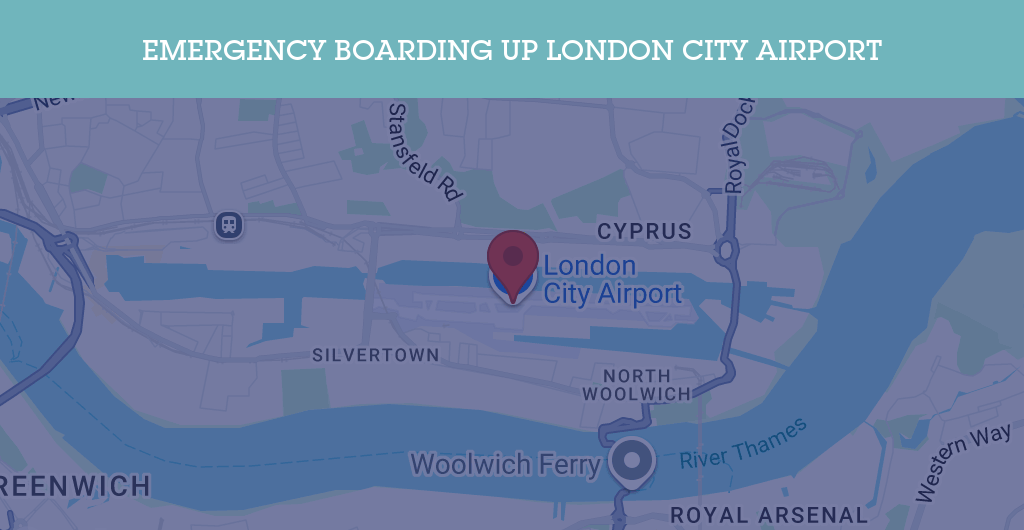
We cover London City Airport and the wider E16 postcode district for urgent and planned boarding-up work. This includes nearby residential blocks, commercial units, and mixed-use buildings where quick, tidy “make safe” work matters.
If you’re just outside E16, we also work closely across nearby areas, including:
London City Airport boarding up FAQs (E16)
How quickly can you attend a smashed window near London City Airport?
Attendance depends on time of day, traffic, and current emergencies. We don’t give guaranteed arrival times. When you call, we’ll take details and give a realistic ETA, then prioritise urgent “make safe” situations in E16.
Will boarding up stop rain getting in around the docks area?
In most cases, yes—good boarding should significantly reduce water ingress. Where frames are badly twisted or the opening is irregular, we’ll explain any limitations and the most weather-resistant temporary approach available on the night.
Can you board up commercial glazing without blocking a shared entrance?
Often, yes. In mixed-use blocks and retail parades, we aim to secure only what’s necessary while keeping access routes as clear and safe as possible. Tell us if there are residents above, shared doors, or fire exits nearby so we can plan the safest method.
I’m a facilities manager—can you provide photos and paperwork for reporting?
Yes. We can provide time-stamped photos, a work description, and an itemised invoice—useful for internal reporting and for insurers. If there are site rules (permits, sign-in, security), mention this on the call.
Can you secure a door that’s been forced but still closes?
Yes. Even if the door shuts, the lock area or frame may be compromised, making it easy to re-enter. We can advise whether boarding is appropriate or whether a more secure temporary solution is needed until repairs are completed.
Do you work out of hours in E16, even late at night?
Yes. We offer out of hours attendance for E16, including nights, weekends, and bank holidays. If it’s urgent—open to the street, vulnerable to entry, or dangerous—we’ll prioritise it.
Is boarding up covered by insurance after a break-in near the airport?
Many policies cover “emergency make safe” work, but cover varies. We recommend contacting your insurer as early as practical and keeping any police reference number. We’ll supply documentation insurers commonly request, but we can’t confirm policy cover.
My property is empty—how do I reduce the chance of repeat attempts after boarding?
Ask for a security-focused approach (anti-tamper fixings, stronger boards, minimising handholds and gaps). Also consider lighting, checking external access points, and making sure windows/doors at the rear are not already compromised.
Get boarding up help in London City Airport (E16)
If you need to secure property tonight—broken glazing, a forced door, or urgent temporary boarding—call us and we’ll talk you through the quickest safe option.
Need help now? Call 020 4634 6384 for 24/7 assistance in E16. Prefer a callback? Ring through and we’ll return your call as soon as we’re free, or email [email protected].
